Ireland's climate places greater demands on roofing than most of continental Europe. Annual rainfall here exceeds 1,200mm across much of the west and southwest, while Atlantic-facing slopes endure sustained high winds and wind-driven rain. Humidity levels remain elevated throughout the year, and freeze-thaw cycles in winter repeatedly test the water absorption of any material. If the materials are not chosen with local conditions in mind, a roofing system that performs adequately in Germany or France may fail prematurely on an exposed Irish site.
This guide covers the main roofing materials used on Irish homes and buildings, how they compare in performance for Irish weather, what sits beneath the outer covering to make the system work, and what financial support is available to help fund roofing and insulation work. Whether you are building new, re-roofing, or planning an extension, understanding the full picture before choosing materials will save time, money and trouble in the long run.
Natural slate: Ireland's traditional roofing material
Natural slate has been the dominant pitched roofing material in Ireland for centuries. Historically quarried in Cork, Kerry and Tipperary, Irish slate has largely been supplemented today by imported slate from Spain and Wales, both of which perform well in Irish conditions.
Natural slate's performance in the Irish climate is difficult to match. Its water absorption rate is close to zero, making it essentially impervious to the freeze-thaw cycles that can cause surface spalling in more porous materials over time. It does not support moss or algae growth to the same degree as concrete surfaces, and when correctly installed it requires minimal maintenance for decades. Lifespans of 80 to 100 years are realistic with periodic inspection and replacement of individual slates as needed.
The practical limitations are weight and cost. Natural slate sits at around 45 to 50 kg/m², which means the roof structure must be capable of carrying the load. On older properties undergoing re-roofing, this is worth checking before specifying slate. Initial material and labour costs are significantly higher than concrete alternatives, though the cost per year of service is comparable or better over the lifetime of the roof.
Best for: Period homes, exposed coastal locations, properties in conservation areas, and long-term investment projects where material quality and appearance matter. Natural slate is also typically required by planning authorities for like-for-like replacement on protected structures.
McMahons stocks a range of natural and fibre cement roofing slates for Irish builds, available across 11 branches and online with delivery and click and collect.

Concrete and fibre cement slate tiles: The practical mainstream choice
Concrete slate tiles are the most widely used roofing material on new residential builds across Ireland today. They offer a good balance of cost, durability and availability, and when correctly installed, they perform well in Irish weather conditions.
McMahons stocks a range of concrete slate and tile profiles, including the Concrete Bullnose Slate Tile 420x330mm in black, the Concrete Flat Slate Tile in both black and turf brown, the Concrete M Profile Tile in black, and the Condron Pantile, a traditional interlocking profile that is well suited to the Irish market.
Concrete tiles interlock to form a highly wind-resistant covering and are available in profiles that suit both traditional and contemporary builds. Their main limitation compared to natural slate is a greater tendency for moss and algae colonisation over time, particularly on north-facing or shaded slopes. Specifying profiles with a smooth face finish or algaecide treatment reduces this significantly.
Lifespan is typically 40 to 60 years with appropriate maintenance. Weight is broadly similar to natural slate, so structural assessment is still worth carrying out on older properties being re-roofed.
Best for: new builds, extensions and re-roofing projects where value for money matters without sacrificing long-term performance.
Clay tiles: traditional character and excellent longevity
Clay tiles are less common in Ireland than in continental Europe but offer a distinctive aesthetic and superior durability to concrete. The firing process that produces clay tiles makes them denser and less porous than concrete, giving them better frost resistance and a longer lifespan, typically 50 to 75 years or more.
Clay tiles are particularly suited to period-style homes, conservation area buildings, and any project where the terracotta appearance is a deliberate design choice. The main drawbacks are higher cost than concrete, greater weight, and more limited availability from Irish suppliers compared to slate or concrete alternatives.
Best for: period-style properties, conservation area builds, and projects where aesthetic quality and longevity take priority over initial cost.
Flat roof materials: EPDM, fibreglass and felt
Flat roofs are increasingly common on Irish extensions, garage roofs, dormer additions and commercial buildings. Choosing the right material matters more than it might appear, because the combination of Ireland's high rainfall and shallow slope, typical of flat roofs, means that drainage performance and membrane longevity are critical.
Traditional bitumen felt is the oldest and cheapest flat roofing option. It remains in use for repair work and low-specification applications but is not recommended for new flat roofs. Lifespan is typically 10 to 15 years and the seams are a recurring failure point.
EPDM rubber membrane is now the standard for quality flat roofing in Ireland. A single-ply vulcanised rubber system, EPDM is fully waterproof, UV-stable, and performs well through freeze-thaw cycling. Lifespan is 25 to 30 years or more with minimal maintenance. It is suitable for DIY installation on smaller areas and is the most common professional specification for residential flat roofs and extensions.
GRP fibreglass is the premium flat roofing choice where a hard, seamless, trafficked surface is needed, such as balconies, roof terraces and walkable areas. It is the most durable of the three, with a lifespan of 25 years or more, but requires professional installation and is more expensive than EPDM.
The most important design consideration for any Irish flat roof is drainage. Falls (the amount the roof drops over a given distance to encourage rainwater to drain towards the gutters or outlets) of at least 1:80 are recommended. Ponding water is the primary cause of flat roof failure in high-rainfall climates, and no membrane material performs well with standing water over sustained periods.
McMahons stocks roofing felt including the Non Breather Felt 1.5m x 30m, used as underlay on pitched tiled and slated roofs to prevent wind-driven moisture ingress. For flat roof membrane systems, speak to your local McMahons branch for current availability.
Corrugated and profiled sheets: agricultural and modern builds
Corrugated steel and PVC profiled sheets are the standard roofing solution for farm buildings, sheds, agricultural structures and an increasing number of contemporary residential and commercial buildings. They are lightweight, fast to install, and cost-effective across large roof areas.
Modern coated steel profiles offer good longevity, typically 25 to 40 years depending on specification and exposure, and their rigidity and interlocking profiles provide strong wind and rain resistance. For agricultural or rural builds, corrugated sheeting is often the practical default.
One important consideration for coastal locations: standard galvanised steel corrugated sheets are vulnerable to accelerated corrosion from salt-laden air. For sites within a few kilometres of the coast, PVC sheets or coated steel profiles with a manufacturer's guarantee for coastal environments should be specified.
McMahons stocks a range of corrugated sheets suitable for agricultural, shed and outbuilding applications.
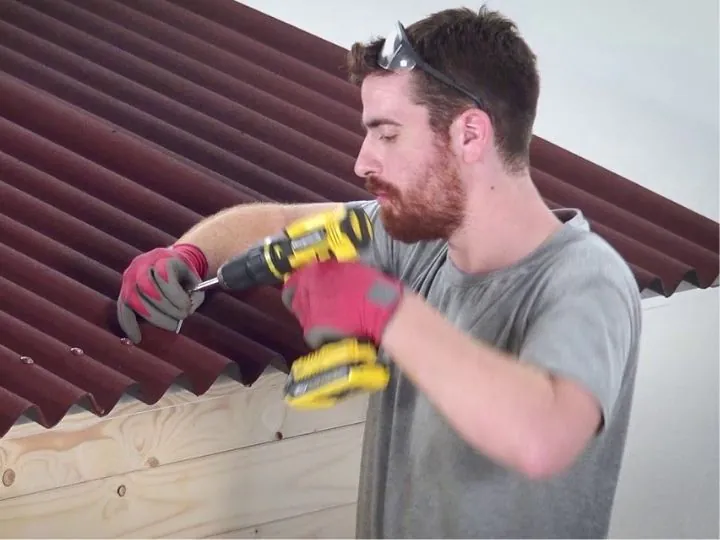

The roofing system: underlay, ventilation, ridge, flashing and trim
The outer covering is only one part of a roofing system. The components beneath and around it determine how well the roof performs in practice. This is the area where most roofing guides fall short, and where poor specification causes the most problems on Irish buildings.
Roofing underlay and felt
Beneath every slated or tiled pitched roof lies a layer of underlay, the secondary waterproof barrier that catches any wind-driven moisture that penetrates the outer covering. McMahons stocks roofing felt including non-breather membrane, which prevents the ingress of wind-driven dust and rain while remaining tear-resistant for easy installation. Non-breather felt requires ventilation gaps to be maintained at eaves and ridge level to manage condensation. Breathable membrane alternatives allow vapour to pass through and are increasingly specified on new builds to simplify ventilation design, particularly in warm roof configurations.
For rafter-level insulation used in attic conversions and warm roof systems, McMahons stocks the 100mm Polyiso Pitched Roof Insulation (Rafter-Fit), a high-performance rigid PIR board designed to be cut and fitted between rafters. If you are re-roofing and considering converting the attic space at the same time, specifying rafter insulation during the roofing works significantly reduces the cost and disruption compared to retrofitting it later.
Ridge tiles and dry-fix systems
The ridge is the apex of a pitched roof where the two slopes meet. It is one of the most exposed and failure-prone elements of any Irish roof, particularly in high-wind locations. Traditional mortar-bedded ridge tiles are increasingly being replaced by dry-fix mechanical systems that secure ridge tiles without relying on mortar, which can crack, degrade and allow water ingress over time.
McMahons stocks ridge tiles and the Eco Ventilated Ridge Roll 6M, a roll-out dry ridge and hip system that provides both a secure mechanical fix and the ventilation required at ridge level. The self-adhesive butyl strips on the underside of the flaps drape over the top row of tiles to form a weather-tight seal without mortar.
Roof ventilation
Adequate ventilation of the roof void is one of the most important and most overlooked aspects of roof specification in Ireland. Without sufficient airflow, warm moist air rising from the living space below condenses in the cold roof void, causing dampness, mould and ultimately timber rot in the rafters and sarking boards.
For cold attics, where insulation is laid at joist level and the attic is left cold, cross-ventilation between the eaves and the ridge is required. For warm attic systems with insulation at rafter level, different rules apply. A 50mm clear air gap must be maintained between the top of the rafter insulation and the underside of the roofing felt in cold roof applications.
McMahons stocks a comprehensive ventilation range including louvre wall vents, the Klober Slate Vent with Cowl 600x300mm for through-slate ventilation of the roof space, and a wide range of soffit and ridge ventilation products. Ventilation and insulation decisions are closely linked. If you are planning attic insulation alongside roofing work, read our attic insulation guide first to understand how the two systems interact, particularly around the requirements for cold attic ventilation gaps at the eaves.
Fascia, soffit and guttering
The fascia board runs along the foot of the rafters, carries the guttering, and forms the outer edge of the roofline. The soffit covers the underside of the eaves overhang and, in most modern specifications, incorporates ventilation slots that allow outside air into the roof void. Both must be correctly installed for the roof ventilation system to function.
McMahons stocks fascia and soffit boards in a range of materials and profiles suitable for Irish residential and commercial buildings.
Lead flashing and roofing trims
Lead flashing seals the junction between the roof covering and vertical surfaces such as chimney stacks, parapet walls, dormer cheeks and abutments. It is one of the most critical weatherproofing elements on any pitched roof, and a failed flashing is one of the most common causes of roof leaks in Irish homes.
McMahons stocks lead roll and flashing including BS-EN 12588 milled lead roll (Lead Roll 4lb 450mm x 6m), patination oil, and self-adhesive flashing tape for repair applications. The full roofing trims range covers verge trims, eaves trim and associated components. For chimney cowls, pots and chimney-related accessories, the chimneys category has a wide range in stock.
Roof windows: bringing in light without compromising weatherproofing
Roof windows are typically specified at the same time as the main roof covering, and the choice of window size and flashing kit must be compatible with the slate or tile being used. Planning the installation of windows in conjunction with the roofing works is the most efficient way to bring light to rooms under your roof..
McMahons stocks Velux roof windows including the Velux GGL CK02 Centre Pivot window (550x780mm) and the Velux GGL CK04 (550x980mm), along with roof window accessories including the Velux EDL SK06 2000 Pro+ Slate Flashing and Collar Kit. This kit is designed for installation into natural slate up to 8mm thick and includes the BDX insulation collar to prevent cold bridging and moisture ingress at the window perimeter.
Key planning considerations for Velux windows in Ireland include:
- Most Velux windows require a minimum roof pitch of 15 degrees, with centre-pivot models performing best at 15 to 90 degrees
- The flashing kit must match the roofing material, with separate kits available for slate, profiled tile and flat tile profiles
- Velux windows that do not project more than 150mm beyond the existing roof plane and are not positioned on the front elevation of the property generally do not require planning permission in Ireland, but this should always be confirmed with your local authority for your specific property
Are there grants available for roofing work in Ireland?
This is one of the most commonly asked questions about roofing in Ireland, and the honest answer is more nuanced than many sources suggest. There is no general grant for replacing roof tiles, slates or membranes available to the average homeowner. However, several funding routes can meaningfully reduce the cost of roofing and related work depending on your circumstances.
SEAI attic and rafter insulation grants
The most widely available route is the SEAI grant for attic insulation. If your roofing project involves replacing or upgrading roof insulation at the same time, significant grant support is available. Grant values for 2026 are:
- Detached house: €2,000
- Semi-detached or end of terrace: €1,500
- Mid-terrace: €1,400
- Apartment (top floor): €1,100
- First-time buyers and qualifying welfare recipients: up to €2,500
Rafter insulation grants for attic conversions, where insulation is fitted between rafters rather than at joist level, are available at higher values through SEAI's One Stop Shop scheme. Combining a re-roofing project with attic insulation is a practical way to access this funding and reduce the overall cost of both works. SEAI grants do not cover the cost of replacing tiles, slates or membranes alone. Read our full attic insulation guide for a detailed breakdown of grant values, eligibility and how to apply.
Housing Aid for Older People Grant
This is the only scheme in Ireland that directly funds roof repair and re-roofing as a standalone measure for eligible applicants.
The grant is administered by local authorities and is available to homeowners aged 66 and older living in poor housing conditions. The maximum grant is €10,700 and can cover up to 100% of approved costs for households with gross income below €37,500. The grant tapers with income and is not available to households earning above €60,000. Eligible works include structural repairs such as re-roofing, re-wiring and other necessary improvements.
For roof repair applications, a letter from your insurance company confirming the repairs are not covered under your policy must be included with the application. Work must not begin before written grant approval is received from your local authority, as retrospective applications are not accepted.
Apply through the Housing Grants Section of your county council or download the application form from your local authority's website.
Warmer Homes Scheme
Homeowners receiving certain social welfare payments may qualify for a fully funded home energy upgrade through SEAI, covering insulation, ventilation and heating system improvements. This does not cover re-roofing directly but can be combined with roofing works where attic insulation is included in the scope.
Home Energy Upgrade Loan Scheme
For homeowners planning a full re-roof alongside energy improvements, SEAI's Home Energy Upgrade Loan Scheme offers government-backed finance from as little as 3% interest on loans between €5,000 and €75,000. These loans can be used alongside SEAI grants to manage the cost of larger combined roofing and insulation projects.
Choosing the right roofing material: a practical guide
Rather than a single recommendation, the right choice depends on your property type, location and priorities.
New build or full re-roof, no budget constraint: Natural slate offers the best long-term performance and lowest cost per year of service in Irish conditions. It is the material of choice for exposed sites, coastal locations and period properties.
New build or re-roof, cost-sensitive: Concrete slate tiles offer excellent value. A well-specified concrete tile roof will last 40 to 60 years with appropriate maintenance and performs well across all Irish climate zones.
Protected structure or conservation area: Check with your local planning authority before specifying materials. Like-for-like replacement with natural slate is typically required, and planning conditions may restrict colour and profile choices.
Coastal property: Prioritise water absorption rating and verify wind uplift resistance in the specification. Natural slate and coated metal profiles are preferable for coastal exposure. Standard concrete tiles can absorb salt moisture over time in severely exposed locations.
Flat roof on an extension or garage: EPDM rubber membrane is the standard professional specification. GRP fibreglass is the choice for surfaces that will be walked on. Both require adequate falls, as drainage design is as important as material selection.
Agricultural or large-span outbuilding: Corrugated steel or PVC profiled sheeting is the practical and cost-effective choice for most rural builds.
West of Ireland (Galway, Clare, Limerick, Kerry, Mayo): Specify materials with the highest water resistance and the most robust mechanical fixing systems available. Wind-driven rain in these regions is persistent and significant, and dry-fix ridge and ventilation systems are strongly recommended over mortar-bedded alternatives.

Shop the full roofing range at McMahons
McMahons stocks the complete range of roofing and ventilation materials for new builds, re-roofing and repair projects, available across 11 branches nationwide and online with delivery and click and collect.
Our in-store teams across Limerick, Cork, Carrigaline, Fermoy, Tralee, Dunmanway, Waterford, Galway, Portarlington, Dublin (Cherry Orchard) and Longford are on hand to advise on material selection, quantities and specification for any roofing project.
Frequently asked questions
What is the best roofing material for Ireland?
For most Irish homes, natural slate offers the best all-round performance in Irish weather, with near-zero water absorption, excellent wind resistance and a lifespan of 80 to 100 years. For budget-conscious projects, concrete slate tiles are the practical mainstream choice with a lifespan of 40 to 60 years. The right answer depends on property type, location, budget and planning requirements.
How long does a slate roof last in Ireland?
A natural slate roof properly installed and maintained will typically last 80 to 100 years or more in Irish conditions. Individual slates may need to be replaced periodically as they crack or slip, but the overall system can outlast several generations. Concrete slate tiles typically offer 40 to 60 years of service life.
Do I need planning permission to replace my roof in Ireland?
Replacing a roof with the same or equivalent materials is generally considered exempt development and does not require planning permission. Exceptions include protected structures, properties in architectural conservation areas, and works that materially alter the appearance of the building. Always confirm with your local planning authority if you are unsure.
What is the difference between breathable and non-breathable roofing felt?
Non-breathable felt prevents water ingress but does not allow vapour to pass through, so adequate ventilation gaps must be maintained at eaves and ridge level to prevent condensation in the roof void. Breathable membrane allows vapour to pass out through the underlay without requiring as large a ventilation gap, reducing the risk of condensation and simplifying warm roof details. Breathable membrane is increasingly the standard specification on new builds in Ireland.
How much does a new roof cost in Ireland?
A full re-roof on a typical semi-detached Irish home costs in the region of €8,000 to €15,000 depending on roof size, material choice, and the extent of any ancillary works required. Natural slate is at the higher end and concrete tiles at the lower. Labour costs vary by region and contractor.
Do I need planning permission for a Velux window in Ireland?
In most cases, no. A roof window that does not project more than 150mm above the existing roof slope, is not located on the front elevation of the house, and does not extend beyond the roof edge is generally considered exempt development under Irish planning regulations. Protected structures and properties in architectural conservation areas may have additional restrictions. Always check with your local authority before proceeding.
What causes moss growth on roof tiles and how do I prevent it?
Moss and algae grow more readily on textured and porous surfaces in damp, shaded conditions, with north-facing slopes particularly susceptible. Concrete tiles are more vulnerable than natural slate or smooth-faced profiles. Prevention options include specifying smooth-faced tiles or tiles with an algaecide treatment, maintaining adequate roof pitch to promote self-cleaning, and trimming overhanging trees that create shade and retain moisture. Periodic treatment with a biocidal wash will control existing growth.
What is a dry ridge system and why is it recommended in Ireland?
A dry ridge system mechanically fixes ridge tiles to the roof without relying on mortar. Traditional mortar-bedded ridges are vulnerable to cracking, shrinkage and detachment in the wind and frost cycles common in Ireland, and a dislodged ridge tile is both a water ingress risk and a safety hazard. Dry-fix systems like the Eco Ventilated Ridge Roll use self-adhesive butyl strips and mechanical fixing to secure the ridge covering reliably, while also providing the ventilation required at ridge level. They are now widely regarded as best practice for Irish pitched roof specification.
Is there a grant for a new roof in Ireland?
There is no general grant for replacing roof tiles, slates or membranes available to the average homeowner. However, if your re-roofing project includes attic insulation, which it should since it is far cheaper to insulate during roofing works than to do it separately, SEAI grants of up to €2,000 are available for most homeowners. Homeowners aged 66 and older may qualify for the Housing Aid for Older People Grant, administered by local authorities, which covers structural roof repairs and re-roofing as a standalone measure up to €10,700. See our attic insulation guide for full SEAI grant details.
